• Search
    MagnetMagnetMagnetMagnet
    EN
    • FR
    • About
      • Our Story >
      • Vision & Mission >
      • Leadership >
      • Advisory Board >
    • Partnerships
      • Government Solutions >
      • Industry >
      • Enterprise >
      • Community >
      • Technology & Integration Partners >
    • Magnet Library
      • Publications >
      • Blogs & Articles >
      • Project Profiles >
    • Products & Services
      • Mark Patterson Speaking Engagements >
      • Data & Technology Solutions >
      • MagnetAI >
      • Magnet Network Live >
      • Segments of Service Offerings >
      • Community Hubs >
      • Incubation, Training & Consultation >
      • Maintenance & Development >
    • Connect With Us
      • General/Media Inquiries >
      • Looking for Work? >
      • Looking to Hire? >
      • Login to my Account >
              No results See all results
              • Home
              • news & articles
              • MagnetAI
              • Preparing for a labour market that won’t hold still 
              string(4) "post"
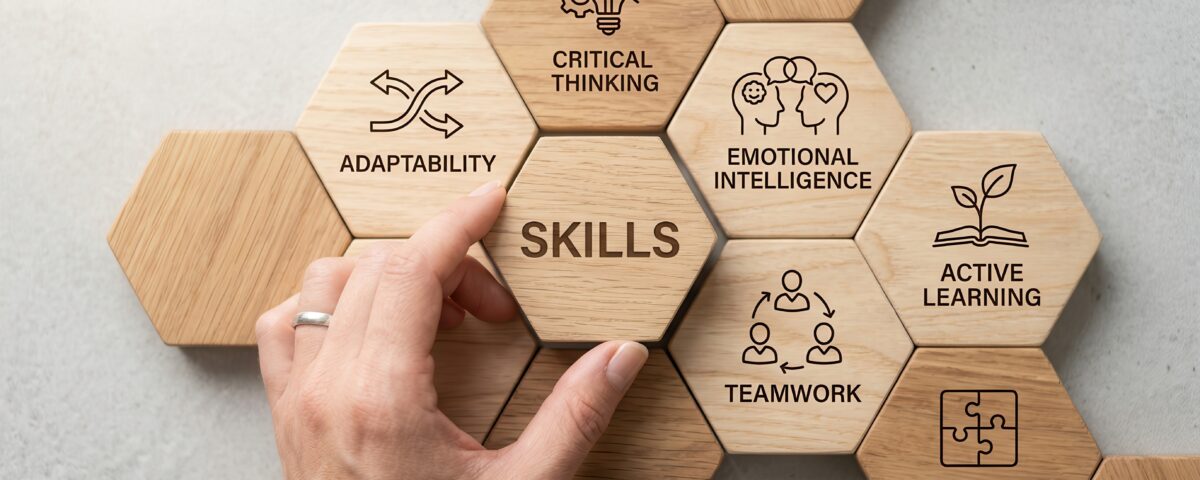
              A series of hexagonal blocks, each featuring a human skill that will be essential in the age of AI (e.g. adaptability, critical thinking, and emotional intelligence).

              Preparing for a labour market that won’t hold still 

              July 28, 2026
              Categories
              • MagnetAI
              Tags
              • AI
              • education
              • Future of Work
              • Skills

              Every quarter, Magnet’s AI adoption work reaches a different mix of audiences, from businesses to skills development leaders. This series highlights the key AI challenges and opportunities that surface through those conversations. 

              Career guidance has long rested on an assumption that professions change slowly enough to study, teach, and revisit every few years. That assumption is becoming harder to sustain, and its erosion can be seen in two trends we’ve seen emerging across the skills development landscape: 

              1. Educators are reaching outside the classroom for help explaining automation risk to students. 
              2. Workforce conferences are building entire programs around equitable AI access for people entering the labor market.

              Both signal the same gap: work is changing at an incredibly fast rate, and the channels to prepare people for the workforce aren’t keeping up. When schools and conferences start pulling in outside voices to close that gap, it suggests the standard tools for preparing the workforce have fallen behind the thing they’re meant to prepare people for.

              There’s an equity dimension too. What’s showing up in these rooms goes beyond the question of whether AI is coming. The more pressing issue is whether the disruption and the opportunity it creates will land evenly across the people trying to build a career right now. Automation risk tends to distribute unevenly, and access to guidance that helps someone navigate that risk follows a similar pattern. That’s part of why this deserves more attention than a standard future-of-work briefing would give it, since the stakes are highest for people with the least institutional support behind them.

              The common instinct is to answer this at the level of the job title, treating some professions as safer bets than others but AI complicates that framing considerably. AI reshapes tasks inside professions, unevenly and often faster than a degree program can track, so a role can look stable on paper while the actual work it encompasses changes significantly over the course of only a few years. The more useful unit of analysis becomes the task rather than the profession, since tasks shift on a timeline that outpaces most curriculum review cycles.

              This also explains why the content of a program carries less weight over time than the capacity it builds for a learner. Technical skill has a shorter shelf life every year, while the ability to keep learning as that skill ages out becomes the more durable asset. Computer science offers a useful illustration here, since the code was always a means of developing a particular way of thinking rather than the end goal itself. Graduates who do well over a longer career tend to be the ones who learned how to keep learning, more than the ones who mastered a single language or framework early on.

              As AI makes production less costly, judgment becomes the more scarce and valuable resource— knowing what’s worth producing, what to trust, and what to question. For people just entering the labor market, that shift raises the stakes on the parts of education hardest to standardize and hardest to measure through conventional metrics. Learning pathways that encourage and enable workers to continually return to being a novice and adapt will allow for more career durability, including for those in the most impacted fields and occupations. 

              For educators and policymakers, the practical takeaway is to favour program design that blends technical credentials with learning that builds durable capacity, judgement, adaptability, and the habit of continuous learning. That kind of capacity is harder to measure than a completion rate, but it holds up considerably better as the labour market continues to shift underneath it.

              In summary:

              • Standard career guidance and curriculum cycles are feeling disruption as AI reshapes tasks within professions.
              • Automation risk and access to navigation support both distribute unevenly, raising the stakes for equity-focused programming.
              • The task, not the profession, is the more accurate unit of analysis for automation exposure.
              • Durable capacity, judgment, adaptability, and the habit of continuous learning, matters more over time than any specific technical skill.
              • Programs and funding should favour building that capacity alongside credentials, not instead of them.


              Share

              Related Reading

              Leadership at a time of radical uncertainty

              Business team in modern boardroom engaging with glowing digital data streams on table surface representing advanced technology and collaborative data-driven corporate strategy execution

              The future of work: why disruption is really a sign of opportunity

              Evening view of the harbor at Iqaluit, Nunavut on the Arctic Ocean. Image credit: jkgabbert

              Canada’s education gap is costing Indigenous communities—closing it starts with access

              Magnet
              • About Us
                • Our Story
                • Vision & Mission
                • Leadership
                • Advisory Board
              • Partnerships
                • Government Solutions
                • Industry
                • Enterprise Partnerships
                • Community
                • Technology & Integration Partners
              • Magnet Library
                • Mark Patterson Speaking Engagements
                • Data & Technology Solutions
                • Magnet AI
                • Magnet Network Live
                • Segments of Service Offerings
                • Project Incubation, Training & Consultation
                • Maintenance & Development
              • Connect With Us
                • General/Media Inquiries
                • Looking for Work?
                • Looking to Hire?
                • Login to my Account
              © 2026 Magnet, Toronto Metropolitan University. All Rights Reserved.
                • Contact
                • Technical Support
                • Terms & Conditions
                EN
                • EN
                • FR
                  Episode 07: Building a Skills-First System

                  With: Dr. Soon Joo Gog – Institute for Adult Learing Singapore

                  Runtime • 38:35
                  Episode 06: Learning isn’t Content Consumption

                  With: Candice Faktor – Disco

                  Runtime • 43:29

                  Episode 05: The Inequality Problem Persists

                  With: Dr. Tracey Burns – National Centre on Education and the Economy

                  Runtime • 34:11
                  Episode 04: Beyond the Degree

                  With: Dr. Asheley Jones

                  Runtime • 29:52
                  Episode 03: Where Talent Meets Opportunity

                  With: Matt Sigelman – Burning Glass Institute

                  Runtime • 38:59
                  Episode 02: Education in Deadlock

                  With: Craig Robinson – Deloitte Canada

                  Runtime • 32:12
                  Episode 01: National Goals, Local Solutions

                  Featuring: Noel Baldwin – Future Skills Centre

                  Runtime • 38:00